Cuban recipe
Old-fashioned queso de puerco: Cuban pork head terrine
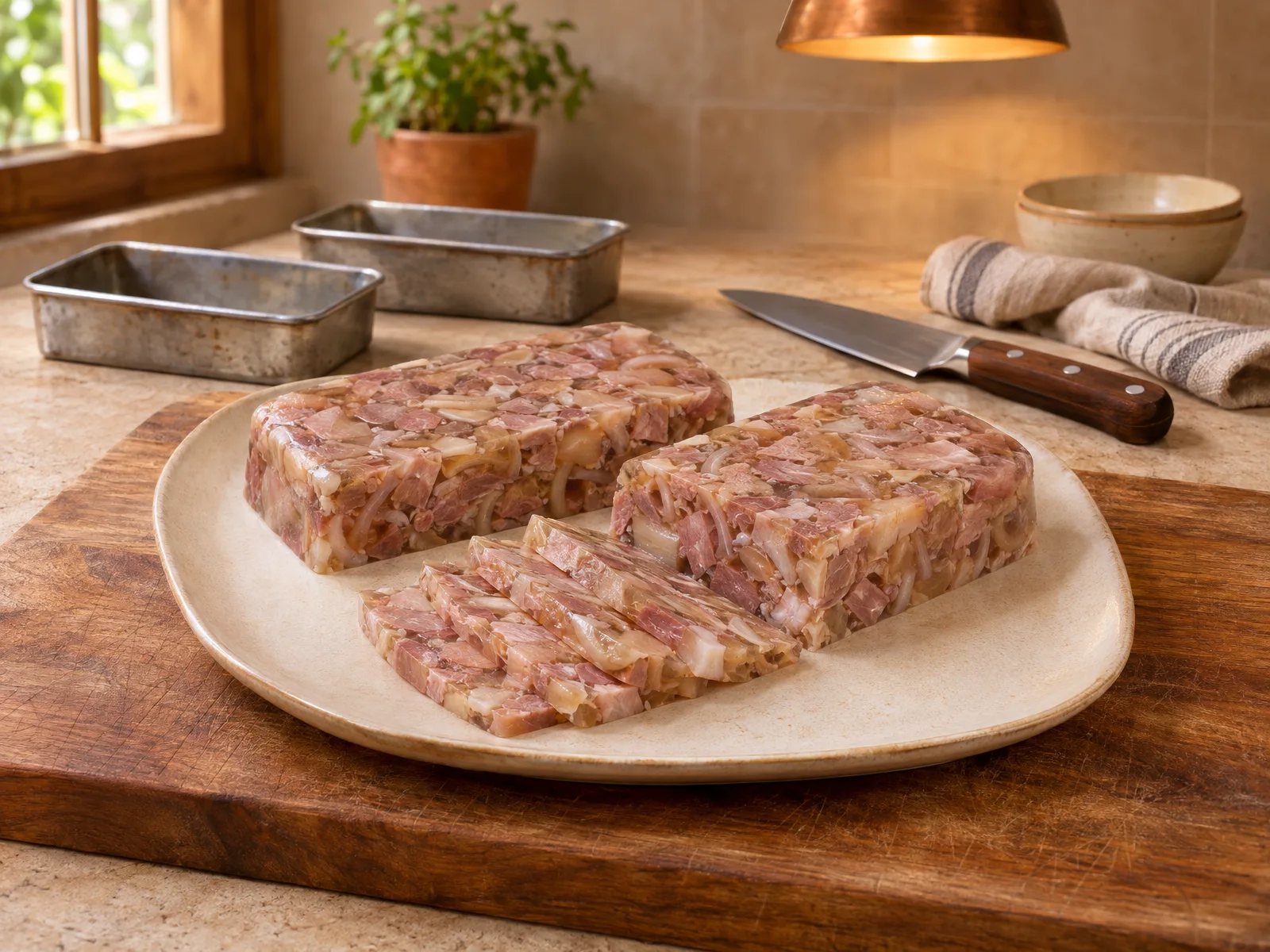
Cuban pork head terrine made with head meat, tongue and ears, finely chopped and set in two shallow rectangular molds. A home adaptation of a 1925 recipe.
- Preparation40 min
- Cooking4 h 45 min
- Total time17 h 55 min
- Servings2 shallow terrines, about 12 appetizer servings
- DifficultyMedium
Queso de puerco contains no cheese: it is a cold terrine made from various parts of the pig's head, served in slices. Delicias de la Mesa, the cookbook published in Havana in 1925, includes a recipe in which the stuffed head is sewn up, wrapped and cooked for several hours to be served the next day.
This version reinterprets the idea using cuts purchased cleaned and prepared from the butcher. They are cooked through, chopped into 5–8 mm pieces and packed into two shallow rectangular molds. Once unmolded, they form two blocks measuring about 20 × 10 cm and approximately 3 cm high, with the finely chopped meats held together by a small amount of set broth. We replace the old format and its egg binder with cooking broth and a small amount of unflavored gelatin to make a sliceable terrine in a home kitchen. We suggest serving it as a Christmas appetizer as part of the series revisiting Cuban recipes of the past.
Ingredients
Check off the ingredients you have.
For cooking the meats
For molding and chilling
Method
Slow-cook the cuts
- Check the cuts already cleaned by the butcher and remove any remaining visible bone or excess fat. Cut the head meat into pieces about 5 cm across and the skin into wide strips. Leave the tongue whole and halve the ears.
- Place all the meats in a large pot with the onion, garlic, bay leaf, peppercorns and 12 g of salt. Add the 3 liters of water, or enough to cover them by 2–3 cm. Bring to a boil and skim the foam from the surface.
- Reduce to a gentle simmer and cook with the lid slightly ajar for 3–4 hours, until the meat, ears and skin are very tender. Add hot water if the level drops and keep the pieces covered. Check that the meat is fully cooked and reaches at least 74 °C/165 °F; for this preparation it should also yield easily when pierced.
- If the tongue still has its outer skin, remove it when tender, usually after 1½–2 hours. Let it cool for a few minutes until it can be handled, remove the skin with a knife and return the peeled tongue to the broth while the other cuts finish becoming tender.
Chop and prepare the binding broth
- Transfer the cooked meats to a tray and work with them while they are still hot. Check that no small bones, teeth or hard cartilage remain. Chop the meat, tongue, tender ears and skin into 5–8 mm pieces; discard any part that is still hard and cannot be cut easily.
- Strain 500 ml of the broth through a fine strainer. Remove the fat from the surface with a spoon or fat separator and boil the broth uncovered in a small saucepan until reduced to 250 ml, about 15–20 minutes. Keep the chopped meats covered while reducing the broth.
- Sprinkle the 7 g of gelatin over the 45 ml of cold water and leave to bloom for 5 minutes. Add the chopped meats to the 250 ml of reduced broth, stir in the ground pepper and heat, stirring, until the entire mixture reaches 74 °C/165 °F. Taste now, with the meat cooked, and adjust the salt.
- Remove the saucepan from the heat. Add the bloomed gelatin and stir until completely dissolved. The meat should be moist, with broth between the pieces, but not swimming in liquid.
Mold, chill and slice
- Immediately divide the mixture between two shallow metal molds measuring about 20 × 10 × 5 cm. Distribute the pieces and press gently with a spatula to eliminate air pockets. Do not exceed 4 cm in depth or place thick weights on top during cooling.
- Place the molds in containers of cold water and plenty of ice, keeping the water below the rims so it does not get into the terrine. Cool for about 20–30 minutes, replenishing the ice as needed.
- Immediately transfer the molds to the refrigerator at 4 °C/40 °F or below, loosely covered and with space around them. Do not wait until the mixture is completely cold outside the refrigerator. Once cooled, cover tightly and leave for 12 hours so the terrine becomes firm.
- Run a thin knife around the edges, unmold and cut into slices with a clean, sharp knife. If the terrine is difficult to unmold, place the base in warm water for just a few seconds, without getting the terrine wet. Serve cold and immediately return any portion you will not consume to the refrigerator.